High-Performance Perimeter Systems for Greater Seattle
Engineered to mitigate marine air oxidation, persistent Puget Sound precipitation, and strict local architectural load ratings.
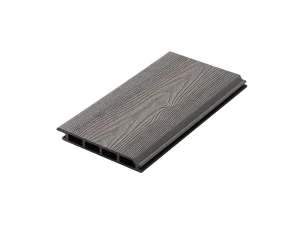
The Seattle Macro Commercial & Industrial Fencing Landscape
Strategic insights for commercial developers, logistics park architects, and multi-family contractors throughout King County and Western Washington.
In the Pacific Northwest (PNW), particularly within the metropolitan areas of Seattle, Bellevue, and Tacoma, perimeter fencing solutions face exceptional ecological and structural stresses. Unlike inland regions with predictable humidity curves, Western Washington endures prolonged moisture contact, sustained fog condensation, cyclic winter freezes, and saline aerosols from Puget Sound. Traditional Western Red Cedar—historically the staple for commercial and residential applications across King, Pierce, and Snohomish counties—has experienced aggressive price surges alongside accelerated decay rates caused by resilient fungal infestations (such as brown and white rot fungi).
Commercial stakeholders, real estate investment trusts (REITs), civil infrastructure contractors, and high-density developers increasingly demand wood-plastic composite (WPC) fencing systems from modern manufacturing facilities that deliver certified structural endurance, flame-retardant performance compliant with WUI (Wildland-Urban Interface) zones, and comprehensive life-cycle cost reduction. Sourcing directly from advanced manufacturing hubs enables tier-1 developers to eliminate broker markups, ensure strict cross-section consistency, and obtain guaranteed ASTM/AAMA test metrics.
Seattle Moisture Saturation
Over 150 wet days per year cause rapid organic degradation in conventional timber. Modern extrusion techniques create impermeable capped shells that drop water absorption rates below 0.5% (ASTM D570 standards).
- Prevents internal hydrostatic swelling
- Eliminates mold, mildew, and moss blooms
- No periodic pressure washing or toxic stains
Seattle Building Codes & Wind
Governed by the Seattle Department of Construction and Inspections (SDCI), perimeter installations must resist sustained maritime gale-force gusts without mechanical deflection or post pull-out.
- Internal reinforcement with 6063-T6 aluminum cores
- Tested up to Exposure Category B & C wind envelopes
- Engineered hardware anchor kits for slab and earth
Decarbonization & LEED v4
With Seattle's ambitious climate action plans, enterprise construction projects require low-embodied-carbon building materials verified by Environmental Product Declarations (EPDs).
- Up to 90% post-consumer recycled polymer/fiber
- Contributes directly to LEED MR Credit points
- 100% recyclable at the end of its multi-decade service life
Manufacturing Resilience: The Modern WPC Extrusion Pipeline
How state-of-the-art Chinese production centers leverage high-precision automation, closed-loop batching, and continuous AI inspection.
The contemporary WPC fencing factory operates under precise Industry 4.0 principles. High-shear twin-screw extruders integrate micro-ground hardwood fibers with medical-grade recycled HDPE matrices, incorporating specialized UV stabilizers, nano-scale coupling agents, and halogen-free fire retardants. This continuous co-extrusion technology applies an omnidirectional 360-degree shielding polymer shell that bonds molecularly to the composite core.
| Performance Parameter | Industrial Composite Fencing | Treated Softwood (Pine/Cedar) | Rigid Vinyl (PVC) Fencing |
|---|---|---|---|
| Water Absorption (24-hr Immersion) | < 0.45% (ASTM D570 Certified) | 22% – 45% (Severe swelling) | < 0.15% (Brittle at low temp) |
| Flexural Strength (Modulus of Rupture) | ≥ 32 MPa (High impact load) | 18 – 24 MPa (Varies by knots) | 14 – 18 MPa (Prone to cracking) |
| Color Fastness (QUV 3000 Hours) | ΔE ≤ 2.5 (High UV Stabilization) | Complete greying within 6 mos | Yellowing / Chalking |
| Rot, Termite & Insect Defense | 100% Impervious (Zero food value) | Vulnerable without chemical seal | Impervious |
| Seattle Wind Load Tolerance | Exceeds 115 MPH (Alloy-reinforced) | Failures under post rot | High blow-out rate on gusts |
Digital Batch Homogenization
Automated gravimetric feeding units calculate density variance in real-time, eliminating density gradients that cause internal warping under temperature swings.
Omnidirectional Capping
Unlike basic surface prints, our protective mantle is co-extruded under 200 bar pressures, guaranteeing complete adhesion that prevents micro-delamination.
Supply Chain Traceability
Every extruded fence slat and structural post carries batch-indexed laser serials, permitting end-to-end QC tracking from polymer feed to container port delivery.
Direct Shipping Logistics: Factory to Port of Seattle & Tacoma
Seamless international maritime delivery with comprehensive customs clearance, full container optimization, and local stocking support.
Procuring directly from our high-capacity Chinese manufacturing base offers North American distributors, commercial fencing contractors, and building material wholesalers deep economic and logistical benefits. By utilizing direct trans-Pacific ocean lanes arriving at the Northwest Seaport Alliance (Terminal 18 in Seattle and Husky/Pierce County Terminals in Tacoma), delivery times are stabilized within 14–18 days on water.
Custom packaging solutions, such as edge-protected steel frame palettes and moisture-barrier shrink wraps, safeguard your shipment through high-humidity sea transit. Furthermore, our products arrive with turnkey factory documentation including mill test certificates, RoHS test reports, and customs-cleared classifications that accelerate rapid distribution across the I-5 corridor.
Initiate Your Custom Seattle Sourcing Matrix
Consult with our structural engineering team for project take-offs, custom extrusion profiles, bulk pricing, and physical specification samples.
Send Inquiry NowFrequently Asked Questions: Commercial Fencing for Seattle
Clear, direct answers for supply chain executives, estimators, architects, and installation supervisors.
How do your WPC fencing systems handle constant Seattle rain?
Our dual-polymer co-extrusion technology shields all organic timber fibers within a high-density, waterproof resin cap. With water permeability under 0.45%, moisture cannot pool internally, eliminating peeling, cracking, or moss proliferation.
Are these fencing modules wind-load certified for King County codes?
Yes. Our perimeter fencing profiles integrate internal channels for high-tensile 6063-T6 aluminum structural inserts. They are engineered to comfortably withstand gust velocities exceeding 115 MPH when installed according to recommended post-depth footings.
Can we mix deck boards, cladding, and fencing panels in a single container?
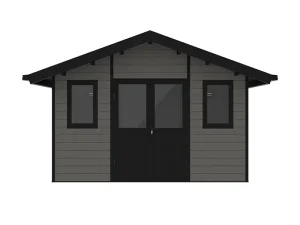
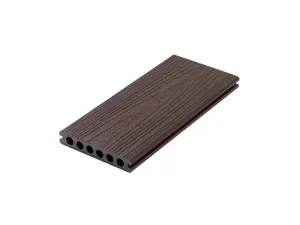
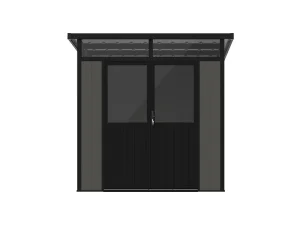
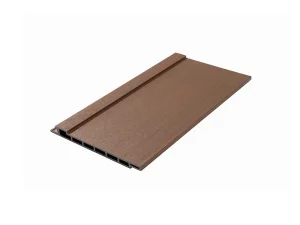
Yes. As a unified exterior composite manufacturer, we encourage consolidation. Importers can mix decking boards, exterior cladding, garden storage sheds, and fencing systems within a single 40ft HQ container to streamline transport logistics.
What is the typical shipping transit time to Seattle and Tacoma ports?
Direct oceanic shipping from our manufacturing base to the Northwest Seaport Alliance terminals typically takes between 14 and 18 days. Standard factory lead time for custom container orders is generally 15 to 20 business days.
Comprehensive Outdoor Composite Solutions for Seattle Projects
Explore our complete inventory of weather-resistant decking, wall panels, outdoor enclosures, and architectural cladding systems.