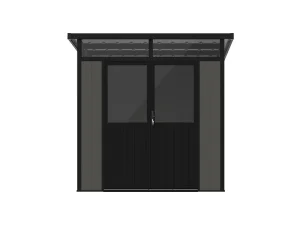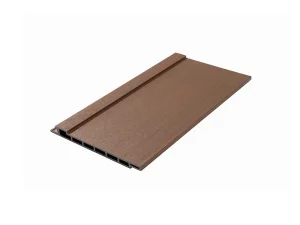
Primary Product Lineup: Series I
Engineered for high-traffic commercial developments, resort pool surrounds, and contemporary architectural façades.
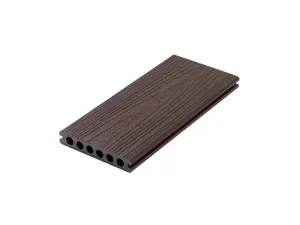
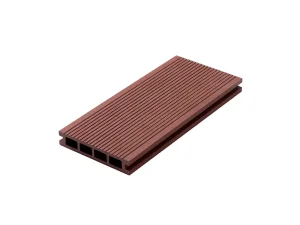
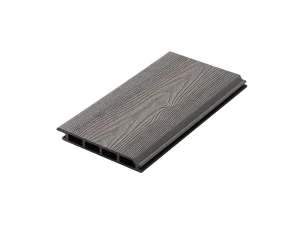
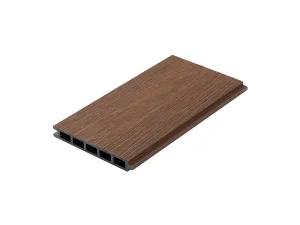
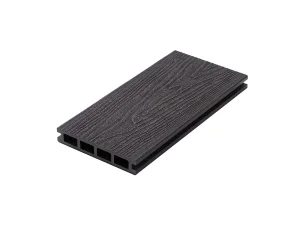
Material Science & Manufacturing Engineering
Decoupling high-performance WPC flooring from conventional softwood timber through multi-component co-extrusion and high-density circular matrices.
360-Degree Shield Technology
Unlike traditional uncapped composite products that suffer from surface oxidation and moisture infiltration, modern co-extruded capped composite decking utilizes an impermeable, modified polyethylene shell. This formulation seals all four faces and groove lines against persistent rain, pool chemicals, and wine or oil stains.
Thermal Dispersion & Cool-Touch
Utilizing high-grade infrared reflective pigments, our advanced decking formulations reflect solar thermal radiation away from surface contact zones. This proprietary compounding process keeps barefoot areas significantly cooler than standard composite boards, meeting high-demand European and Middle Eastern pool surround specifications.
High Dimensional Stability Matrix
Reinforced with 60% reclaimed hardwood micro-fibers, 30% recycled high-density polyethylene (HDPE), and 10% coupled stabilizers. The resulting cellular core demonstrates an extremely low coefficient of thermal expansion, mitigating warpage, board creep, and shear stress across varying climatic cycles.
Direct Performance Matrix: WPC vs. Treated Softwood
Engineered performance analysis based on standard ASTM and EN international outdoor building material benchmarks.
| Evaluation Parameter | Forestar Capped WPC Systems | Treated Pine / Pressure Softwood | Industrial Advantage |
|---|---|---|---|
| Maintenance Overhead | Zero sealing, staining, or oiling; water clean only | Bi-annual chemical staining & water-repellent sealing | Eliminates up to 85% of life-cycle maintenance costs |
| Moisture Absorption | < 0.5% after 24-hr full immersion (ASTM D1037) | 15% to 25% cyclic swelling and dimensional shift | Immune to rot, fungal decay, and sub-surface splitting |
| Slip Resistance Rating | Class C / R11 micro-grooved anti-slip friction surface | Hazardous when wet or compromised by algae growth | Safe for bare feet around public swimming pools & marinas |
| Surface Degradation | Encapsulated anti-UV stabilizers, no splinters or checks | Severe checking, splintering, and natural twisting | Zero risk of barefoot splinters; stable aesthetic life |
| Environmental Profile | Up to 90% recycled plastics and post-industrial wood | Depletes old-growth timber; uses chemical preservatives | Contributes to LEED points and circular construction |
China Factory Direct Supply Chain & Global Purchasing Power
Streamlined manufacturing intelligence, multi-product container consolidation, and integrated export risk mitigation.
Consolidated Mixed-SKU Shipping
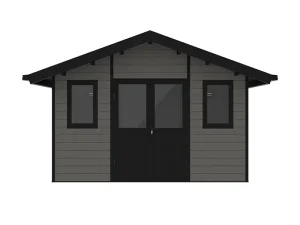
Importers reduce sea freight exposure by consolidating WPC decking boards, co-extruded wall cladding, modular fencing panels, and flat-packed outdoor garden sheds within a single 40ft HQ container. This operational flexibility optimizes inventory velocity and significantly lowers warehousing overhead.
OEM/ODM & Private Label Packaging
We provide full white-label capabilities for multinational building material chains, architectural distributors, and timber merchants. Features include laser-etched batch branding, customer-specific structural profiles, bespoke installation clips, and shrink-wrapped retail packaging equipped with multilingual barcoding.
Strict Quality Control & Lot Traceability
Every extrusion batch undergoes standard mechanical tests: flexural stress, modulus of elasticity (MOE), QUV accelerated weathering, and boiling-water adhesion tests. Batch numbers stamped on each profile guarantee raw material traceability from polymer pellet intake to project site installation.
Regional Climate Engineering & Compliance Profiles
Engineered formulations tailored to regional structural standards, thermal variances, and regulatory mandates.
Nordic Freeze-Thaw Resistance
Deployed in extreme climates like Finland, Sweden, and Canada. Zero moisture absorption within the capped polymer prevents internal ice expansion, which is the primary cause of cracking in timber and porous composite profiles subjected to rapid sub-zero cycling.
Arid UV & Desert Heat Stabilization
Engineered for high solar irradiance environments like the Middle East, Texas, and Australia. Compounded with hindered amine light stabilizers (HALS) and antioxidant complexes to maintain structural integrity and colorfastness under sustained UV index ratings above 11.
Tropical High-Humidity & Saline Zones
Formulated for coastal resorts, marinas, and humid regions across Southeast Asia, the Caribbean, and South America. High-density outer shells prevent marine borer damage, algae biofilm accumulation, and corrosion from airborne salt spray.
Global Industry Mega-Trends & Decarbonization
Tracking the macroeconomic shift toward circular building materials, fire compliance, and AI-driven automated extrusion.
Circular Economy & Recycled Polymers
Stricter green public procurement and LEED v4.1 certification criteria demand measurable carbon offsets. By using up to 90% recycled plastics and circular reclaimed wood flour, modern WPC acts as a durable carbon sink, preventing waste plastics from entering marine and landfill systems.
Advanced Fire-Retardant Standards
Global commercial building codes require Class Bfl-s1 or ASTM E84 Class A fire-rated composite flooring. Modern multi-layer co-extrusion incorporates inorganic nano-flame retardants within the outer shell, drastically reducing smoke production and preventing molten droplet spread.
AI-Enhanced Precision Extrusion
Automated extrusion lines monitor melt pressure, temperature gradients, and profile wall tolerances in real-time. This machine-driven oversight minimizes inner stress imbalances within hollow decking boards, ensuring structural uniformity and straight profile lines across large architectural builds.
Technical & Global Procurement FAQ
Comprehensive engineering clarity and procurement procedures for international distributors, quantity surveyors, and project developers.
Primary Product Lineup: Series II
Modular composite fencing, UV-resistant cladding panels, and anti-slip commercial profiles for international building tenders.