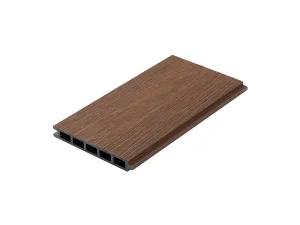
Engineered Architectural Profiles & Outdoor Living Systems
Review our high-performance composite decking, waterproof rainscreen cladding, heavy-load outdoor storage sheds, and modular privacy systems engineered for commercial specifiers and volume distributors worldwide.
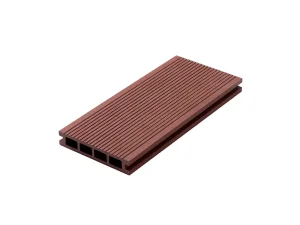
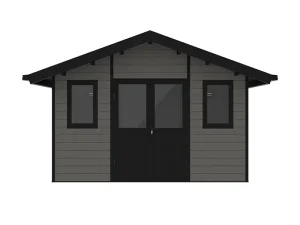
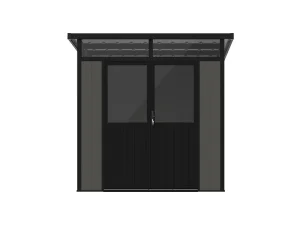
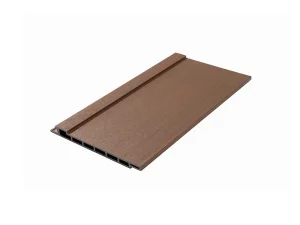
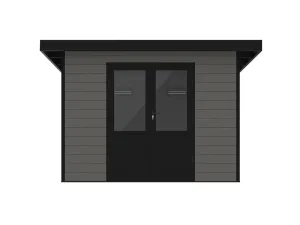
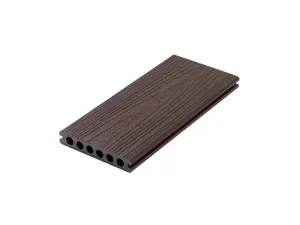
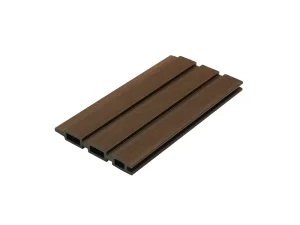
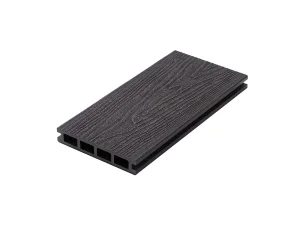
The Paradigm Shift in Exterior Architectural Façades
Modern building envelope specifications have moved beyond conventional timber and early polymer composites. Explore how 360-degree co-extrusion technology and advanced thermal stabilization are solving historic longevity and maintenance bottlenecks.
Generation 1 to Gen 3 Multi-Extrusion
Early uncapped composites suffered from surface chalking, fungal penetration, and rapid solar discoloration. Modern Generation 3 capped WPC claddings feature an impenetrable, 360-degree fluorocarbon-modified HDPE shield that seals the internal composite core against atmospheric oxidative stresses, volatile chemical exposure, and moisture saturation.
Life-Cycle Cost Parity Analysis
While Siberian Larch or pressure-treated softwoods show lower initial purchase costs, their 10-year total cost of ownership (TCO) escalates drastically due to biennial sanding, toxic biocidal treatments, and polyurethane sealing. Co-extruded WPC cladding neutralizes ongoing maintenance expenses, achieving full capital expenditure parity within 3.5 years of installation.
Embodied Carbon & ESG Procurement
Global architectural specifications increasingly require compliance with circular economy guidelines. Operating under Anhui Fumeida New Material Technology Co., Ltd., Forestar integrates up to 90% post-consumer polymer fractions and secondary industrial wood flour, preventing landfill diversion and contributing valuable points toward LEED v4.1 and BREEAM certifications.
China Factory 4.0: Autonomous Co-Extrusion & Supply Chain Resilience
Located at 5 Mezigang Road, North District Industrial Park, Xuancheng, Anhui, our production infrastructure utilizes advanced polymer compounding, computerized gravimetric feeding, and precision laser calibrators to guarantee dimensional repeatability and mechanical integrity.
Continuous Melt-Flow Control
Automated twin-screw extruders continuously regulate resin viscosity, processing temperature, and shear stress, preventing cellular micro-voids and assuring uniform material density throughout the profile cross-section.
In-Line Laser Calibrators
Optical laser micrometers detect sub-millimeter dimensional tolerances in real time. Expansion joints, hidden clip grooves, and interlocking tongue-and-groove channels adhere strictly to ±0.3mm engineering allowances.
Raw Material Homogenization
Wood fiber particles are classified via multi-stage centrifugal air separation to 80-100 mesh, followed by vacuum dehydration below 1% residual moisture to prevent internal gassing and micro-fractures during high-pressure shaping.
Intermodal Shipping Consolidation
Factory-direct consolidation allows volume importers to pack composite decking, exterior wall cladding, boundary fencing, and prefabricated garden sheds within the same shipping container, optimizing freight cube efficiency.
Comparative Performance & Material Characterization
To assist structural engineers, commercial developers, and procurement authorities, our products are certified through accredited test regimens verifying mechanical flexure, flame propagation, moisture impermeability, and acoustic dampening.
| Evaluation Parameter | Test Standard / Protocol | Forestar Capped WPC Series | Traditional Softwood (Treated) | Standard Uncapped WPC |
|---|---|---|---|---|
| Bending Elastic Modulus | ASTM D790 / EN 310 | ≥ 3,450 MPa (High Rigidity) | 2,100 - 2,800 MPa (Variable) | 2,400 MPa |
| Flame Spread & Smoke Density | EN 13501-1 / ASTM E84 | Class B-s1, d0 / Class A | Class D or Untested (Combustible) | Class C / Class B |
| 24h Water Absorption Ratio | ASTM D1037 / EN 317 | ≤ 0.35% (Hydrophobic Capping) | 18.0% - 28.0% (High Swelling) | 2.2% - 4.5% |
| Accelerated UV Weathering | ISO 4892-2 (3,000 hrs Xenon) | ΔE*ab < 2.0 (No Chalking) | Severe Greying & Surface Fiber Decay | ΔE*ab > 6.5 (Noticeable Fade) |
| Linear Thermal Expansion (α) | ISO 11359-2 | 3.2 × 10¯&sup5; K¯¹ | Orthotropic Swelling (Moisture Driven) | 4.8 × 10¯&sup5; K¯¹ |
| Biological Decay & Termites | ASTM G21 / AWPA E1 | Rating 0 (Complete Immunity) | Requires Periodic Toxic Biocide | Prone to Mold in High Humidity |
Worldwide Architectural Application Scenarios
Commercial building envelopes require tailored mechanical and thermal mitigation strategies depending on local microclimates. Our WPC cladding formulations are customized to endure extreme localized environmental challenges.
Nordic & Sub-Zero Freeze-Thaw Zones
Deployment: Finland, Sweden, Austria, Northern USA, Canada.
Engineering Focus: Zero interior moisture absorption prevents cryogenic expansion and microscopic board ruptures during rapid -35°C freeze-thaw cycles. Aluminum sub-framing clip configurations accommodate thermal contractions while maintaining structural deflection rigidity under heavy perimeter snow packs.
High-Irradiance & Arid Desert Environments
Deployment: UAE, Saudi Arabia, Texas, Southern Spain, Australia.
Engineering Focus: Formulated with concentrated hindered amine light stabilizers (HALS) and inorganic ceramic pigments, our panels deflect infrared thermal radiation, preventing excessive heat absorption, surface softening, and warpage under sustained 48°C ambient atmospheric heat.
Coastal Marine & Tropical Monsoons
Deployment: Florida, Caribbean, Southeast Asia, Coastal Chile.
Engineering Focus: Complete chemical inertness against saline spray, high airborne chlorides, and cyclical 98% relative humidity. Fastened using 316-grade marine stainless-steel clip systems that eliminate electrolytic corrosion streaks and facade discolorations.
Specifier & Importer Procurement Advisory
Detailed answers addressing regulatory building approvals, technical envelope mechanics, sample verification, and OEM container consolidation protocols.
How does WPC cladding behave regarding fire reaction classifications?
Our co-extruded exterior wall cladding is engineered with mineral-based, non-halogenated flame retardants integrated into both the core composite and the exterior polymer shell. Under EN 13501-1 testing, our system achieves up to Class B-s1, d0 (indicating very limited combustibility, negligible smoke production, and zero flaming droplets), making it compliant with mid-rise and residential envelope codes across the EU, North America, and Australasia.
What is the recommended sub-construction and ventilation clearance?
WPC cladding operates on the drained and back-ventilated rainscreen principle. Substructures require an unobstructed vertical air cavity of at least 20mm to 30mm behind the boards, with continuous open airflow slots at the base and parapet. Aluminum or galvanized steel battens should be spaced at a maximum of 400mm center-to-center for residential installations and 300mm for high wind-load commercial developments.
How are thermal expansion and contraction mechanically handled?
Polymer composites exhibit linear thermal movement dictated by ambient temperature shifts. Our cladding series utilizes engineered concealed fasteners that anchor one end while permitting controlled sliding expansion on adjoining clips. Installers must maintain 4mm to 6mm butt-joint gaps at board ends depending on ambient installation temperatures according to the Forestar Technical Manual.
Can overseas buyers order custom profiles, lengths, and RAL colors?
Yes. As an original equipment manufacturer (Anhui Fumeida New Material Technology Co., Ltd.), we provide full custom tooling and precision spectrophotometric color matching based on Pantone or RAL color standards. Custom lengths from 2.2m to 5.8m can be extruded to optimize 20ft and 40ft high-cube container packing without waste.
What documentation and third-party certifications are available for tenders?
We provide full project submittal packages including ISO 9001 and ISO 14001 factory audits, CE declarations of conformity, FSC chain-of-custody documentation, REACH chemical safety compliance, and comprehensive third-party test reports from SGS and Intertek validating mechanical, fire, weathering, and slip performance.
Where can global partners inspect physical profiles and meet our technical directors?
In addition to factory visits at our manufacturing complex in Xuancheng, Anhui, our international sales and engineering team regularly exhibits at major building exhibitions worldwide, including PISCIMAD 2026 in Madrid (Booth 7A49). In-person inspections and full specification consultations can also be coordinated directly with our export engineering desk.
Complementary Architectural Products & Outdoor Structures
Explore our full line of weather-tight modular garden sheds, capped co-extruded decking boards, and low-maintenance privacy screens available for consolidated container shipments direct from our production facility.