
Primary Architectural Product Specifications
Engineered for high foot-traffic, exterior weatherability, UV stabilization, and low-maintenance resilience across 45+ export jurisdictions.
The Global Commercial & Industrial Landscape of Outdoor Decor
Analyzing structural timber replacement cycles, circular economy mandates, and total cost of ownership (TCO) across modern commercial and residential construction.
Structural Transition Away from Virgin Timber
Global architectural trends indicate an unprecedented acceleration from chemically-treated softwoods (CCA treated pine) and tropical hardwoods (Ipe, Cumaru, Teak) toward high-performance Wood-Plastic Composites (WPC). Depleting forestry reserves, rising timber tariffs, and strict deforestation regulations (such as the EU Deforestation Regulation - EUDR) have pushed Tier-1 infrastructure developers toward engineered composite assemblies that deliver a 25+ year design lifespan without chemical leachates.
Zero Deforestation FootprintCommercial Life Cycle Economics (TCO)
While virgin softwood possesses lower initial procurement expenditure, its annualized lifecycle cost escalates within 36 to 48 months due to required bi-annual pressure-washing, sanding, staining, and chemical sealing. In hospitality resorts, public boardwalks, and multi-family residential developments, Forestar capped composite decking reduces maintenance operating expenditures (OpEx) by up to 82% over a 15-year operational horizon, rendering capital investments immediately accretive.
82% OpEx ReductionLEED & BREEAM Green Building Integration
Modern architectural specifications mandate quantifiable Environmental Product Declarations (EPDs). By incorporating up to 90% reclaimed high-density polyethylene (HDPE) and industrial timber processing by-products, Forestar composite profiles systematically contribute to LEED v4/v4.1 credits in Materials and Resources (MRc), Building Product Disclosure and Optimization, and Sourcing of Raw Materials, establishing compliance for municipal tenders.
LEED v4/v4.1 QualifiedChina Factory Supply Chain Resilience & Manufacturing Efficiency
Operating from our Xuancheng manufacturing campus in Anhui, Anhui Fumeida New Material Technology Co., Ltd. integrates automated polymer compounding with high-yield continuous extrusion.
Closed-Loop Raw Material Compounding
Vertical upstream integration enables complete quality oversight. Post-consumer HDPE pellets undergo multi-stage wash-float purification, spectrographic separation, and micro-pulverization before compounding with kiln-dried, debarked wood fibers. This mitigates density variances and guarantees void-free structural density across all extrusion lines.
Multi-Cavity Twin-Screw Co-Extrusion
High-torque parallel twin-screw extruders deliver uniform melt-flow rates across complex cross-sections. In-line 360-degree capping technology molecularly fuses a modified polymer shield onto the core, eliminating mechanical peeling and ensuring moisture absorption thresholds well below 0.5% (ASTM D1037).
Automated In-Line Defect & Color Control
Every meter of extruded profile passes continuous laser-micrometer dimensional scanning and spectrophotometric color variance sensors (Delta E < 0.8). Profile straightness, hollow-core wall thickness, and surface micro-embossing depth are logged to guarantee zero batch-to-batch variation for large container consignments.
Consolidated Multi-Line Container Loading
Importers leverage our comprehensive ecosystem to cross-consolidate decking boards, cladding panels, perimeter fencing, and flat-packed modular garden sheds in single 40ft High Cube containers. This single-manifest consolidation optimizes ocean freight yields, minimizes drayage costs, and shortens SKU lead times.
Localized Engineering Applications Across Global Climate Zones
Forestar composite assemblies undergo empirical stress simulations to perform reliably under diverging environmental pressures—from Scandinavian snow loads to Middle Eastern thermal radiation.
Nordic & Alpine: Freeze-Thaw Resistance
Deployment: Helsinki, Finland & Vienna, Austria
Severe freeze-thaw cycles fracture conventional timber and porous stone when trapped water expands. Forestar capped decking and composite storage sheds feature near-zero pore capillarity. Standard EN 15534-1 testing confirms zero delamination, rupture, or flexural fatigue after 100 consecutive freeze-thaw cycles (-20°C to +60°C). Structural garden shed roofs withstand heavy snow-pack loads without roof sagging or joint displacement.
Desert & High-UV: Thermal Dissipation
Deployment: Dallas, USA & GCC / Gulf Regions
Extreme solar irradiance deteriorates polymer molecular chains and creates uncomfortably hot walking surfaces. Forestar incorporates automotive-grade UV stabilizers (HALS) and inorganic infrared-reflective pigments into the co-extruded capping shield. The boards remain structurally rigid up to 75°C surface temperatures, maintaining tactile comfort under bare feet and exhibiting zero chalking or rapid fading under continuous Xenon arc weathering (ASTM G155).
Tropical Maritime: Saline & Anti-Microbial
Deployment: Medellín, Colombia & Coastal Resorts
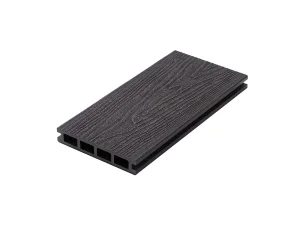
Salt-mist humidity accelerates fungal growth, rot, and structural fastener corrosion in natural wood decking. EclipseGrain and TimberFlow composite profiles exhibit natural immunity to fungal decay (EN 12038 Class 1 rating). Coupled with our A4/316-grade marine stainless steel concealed fasteners, the decking surface preserves a high-traction wet slip coefficient (DIN 51130 R11/R12) for commercial swimming pool perimeters and waterfront boardwalks.
Material Science Performance: Forestar WPC vs. Alternative Substrates
Quantitative material criteria confirming why Tier-1 architectural planners specify co-extruded composites over traditional wood profiles.
| Performance Dimension | Forestar Capped WPC | Untreated Softwood | Pressure-Treated Pine | Tropical Hardwood (Ipe/Teak) |
|---|---|---|---|---|
| Annual Maintenance Needs | Zero (Soapy water wash) | Heavy (Bi-annual seal/stain) | High (Annual chemical paint) | High (Periodic hardwood oiling) |
| Moisture Absorption (24h) | < 0.4% (ASTM D1037) | 22% – 35% | 15% – 28% | 8% – 14% |
| Fungal & Termite Decay | Impervious (Inorganic matrix) | High risk within 24 mos | Moderate (Biocide leach) | Natural resistance (Costly) |
| Surface Splintering | Guaranteed Splinter-Free | Severe check & splinter | Frequent splintering | Occasional grain checks |
| UV Degradation & Color Shift | Delta E < 2.5 (Automotive UV) | Greys within 90 days | Discolors & chalks rapidly | Fades to dull grey patina |
| Fire Safety Classification | Class B-s1 (EN 13501-1) | Class D / E | Class D | Class B / C (Untreated) |
| Circular Recycled Content | Up to 90% Recovered | 0% (Virgin forest logging) | 0% (Virgin forest logging) | 0% (Rainforest depletion) |
Technology Roadmap & Future Engineering Outlook
Forestar's research and development engineering trajectory aligns with high-performance circularity, bio-polymer integration, and smart exterior systems.
Phase 1: Bio-Resin & Agricultural Waste Matrices
Pioneering the synthesis of next-generation bio-based polyolefins derived from agricultural cellulose waste and plant starch. This initiative further decouples raw material feedstocks from virgin petrochemical supply chains, lowering embodied carbon by an additional 34% per metric ton of manufactured composite boards.
Decarbonized Material SciencePhase 2: Nano-Ceramic Co-Extruded Capping
Integrating nano-particle ceramic barrier additives directly into the outer thermoplastic shield. This technological advancement elevates scratch resistance past Shore D 75, repels harsh oil-based hydrocarbons (such as grilling grease), and optimizes radiant heat reflectance for commercial pool decks in equatorial markets.
Ultra-Hard Nano ShieldPhase 3: Building-Integrated Photovoltaic (BIPV) Sheds
Expanding our modular storage shed line into autonomous micro-utility hubs. Integrating low-profile, flexible thin-film solar arrays into composite shed roofs enables off-grid garden sheds to power high-capacity battery systems, automated garden irrigation controls, and electric mobility charging stations.
Micro-Grid Modular OutbuildingsLocalization Support & Compliance Assurance for Importers
Ensuring seamless market entry, customs compliance, and structural endorsement across European, North American, Australasian, and Latin American jurisdictions.
Testing Accreditation
Fully compliant with ASTM D7032 (Standard Specification for Establishing Performance Ratings for Wood-Plastic Composite Deck Boards) and European EN 15534-1/4. SGS test dossiers are certified for mechanical rupture, water immersion, slip resistance, and accelerated cyclic aging.
Chemical & Environmental Safety
Strict compliance with EU REACH Regulation (EC 1907/2006), verifying our formulations are completely free from SVHC (Substances of Very High Concern), cadmium, lead, or phthalate plasticizers. RoHS compliant, ensuring child- and pet-safe installations.
OEM/ODM Custom Extrusion
In-house CNC mold and die design capabilities allow rapid prototyping of custom profiles, exclusive surface woodgrain textures, specific cut lengths (to eliminate jobsite wastage), and localized retail point-of-sale private label carton packaging.
Installation Engineering Manuals
Providing multi-language architectural detail packets, substructure span calculations, joist spacing guidelines (300mm–400mm o.c.), expansion gap thermal formulas, and concealed clip diagrams to prevent contractor errors on site.
Specialized Exterior Profiles & Outdoor Living Structures
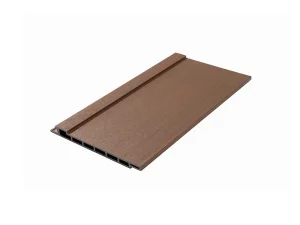
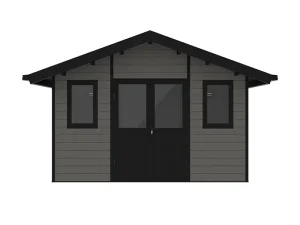
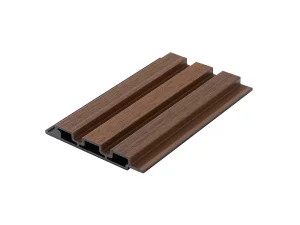
High-tensile composite wall siding, heavy snow-load garden outbuildings, and precision co-extruded architectural fence panel systems.
Frequently Asked Questions: Sourcing & Engineering Forestar Products
In-depth responses for building material importers, structural engineers, landscape architects, and procurement officers.
What is the structural composition of Forestar composite decking and cladding?
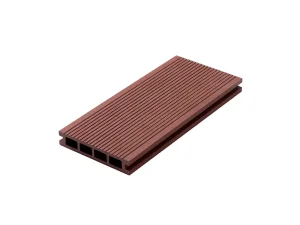
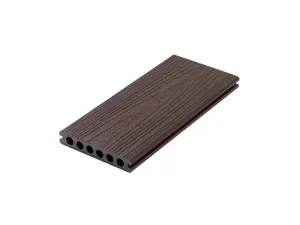
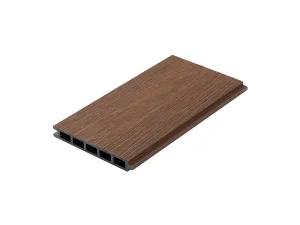
Forestar composite profiles are formulated using a thermo-mechanical co-extrusion process. The core consists of approximately 55–60% reclaimed industrial wood fiber (sustainably processed, moisture-evaporated) compounded with 30–35% recycled high-density polyethylene (HDPE). The remaining 10% comprises high-grade performance coupling agents, UV stabilizers (Hindered Amine Light Stabilizers), anti-oxidants, and inorganic color pigments. Second and third-generation profiles feature a seamless 360-degree co-extruded capping shield that provides absolute water resistance and stain barrier protection.
How does Forestar manage thermal expansion and contraction (ΔL) across extreme climates?
Like all polyolefin composites, Forestar WPC exhibits a predictable coefficient of linear thermal expansion (CLTE), approximately 3.0 to 4.0 x 10⁻⁵ mm/mm/°C. We solve this through our engineered hidden clip fastener system, which allows linear expansion within the longitudinal plane while keeping the deck plane flat. Our installation manuals provide exact temperature-indexed butt-joint spacing tables (e.g., leaving a 3mm to 6mm gap depending on ambient temperature at the time of installation) to ensure perfect stability from -30°C winters to +50°C summer sun.
Can multiple outdoor decor categories be consolidated into one ocean shipping container?
Yes. A primary operational advantage of Anhui Fumeida New Material Technology Co., Ltd. is our unified manufacturing campus. Importers can consolidate decking boards, wall cladding, composite fencing profiles, and flat-packed modular garden sheds inside a single 40ft High Cube container. We design custom pallet lengths and carton bundling to maximize cubic volume utilization (CBM) while avoiding shipping damage, greatly simplifying customs clearance and SKU management.
What fire rating certifications do Forestar composite decking and cladding hold?
Forestar composite profiles can be formulated to achieve Class B-s1, d0 flame spread compliance under European Standard EN 13501-1, as well as Class B rating under American standard ASTM E84 (Surface Burning Characteristics of Building Materials). This makes our architectural cladding and decking systems suitable for commercial multi-family residential developments, civic boardwalks, and urban rooftop terraces that require strict exterior fire mitigation.
What is the snow load rating and structural design of the modular composite garden sheds?
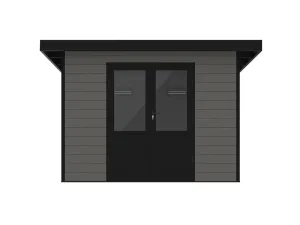
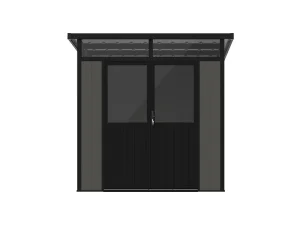
Forestar garden sheds (including MiniStar and CeilingStar models) feature an internal structural skeleton of galvanized steel uprights and roof trusses, sheathed in double-walled, interlocking tongue-and-groove WPC panels. This engineering handles heavy snow loads of up to 120 kg/m² and sustained wind gusts up to 100 km/h without structural deformation. The composite walls will not rot, rust, dent, or require painting like traditional wood or sheet-metal sheds.
How does Forestar assist distributors with localized private labeling and marketing?
We provide complete OEM/ODM support for trade brand partners. This includes custom protective peel-off film with client branding, customized outer carton print graphics, multilingual assembly brochures, physical architect sample kits, and comprehensive high-resolution digital media lookbooks. Our engineering department can also develop custom extrusion dies for exclusive regional profile designs with rapid turnaround times.
Specify Forestar Composite Systems for Your Target Market
Connect with our technical export engineering team in Xuancheng, Anhui, China. Request full technical dossiers, third-party laboratory certifications, physical architect sample boxes, or schedule an in-person factory tour.