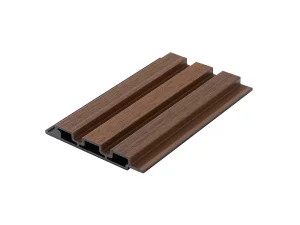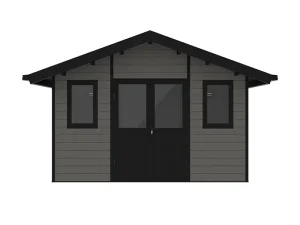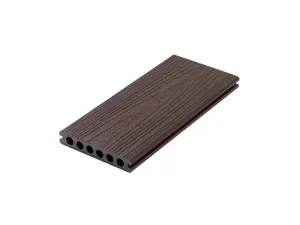
Featured Precision Composite Decking & Cladding Profiles
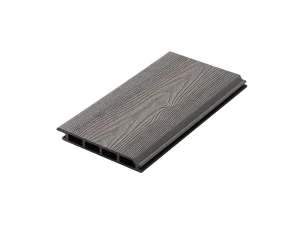
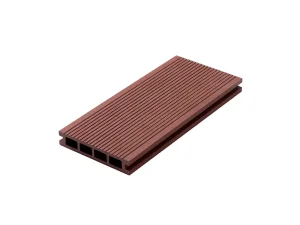
Export-ready structural profiles manufactured in Xuancheng, Anhui. Calibrated with continuous inline laser interferometry to ensure consistent width across entire production runs.
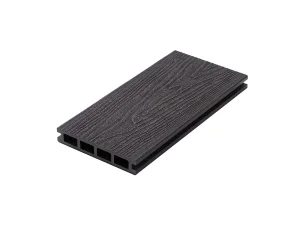
How Wide Are Deck Boards? Engineering Standards vs. Real-World Applications
In architectural specification, asking "how wide are deck boards" is not simply a query of aesthetics—it defines structural joist centers, moment of inertia ($I_x$), shear modulus, dynamic thermal gap kinematics, and container freight economics.
Standard Narrow Planks: 90mm – 95mm (Nominal 4")
Commonly specified in high-moisture maritime platforms, high-slope ramps, and traditional nautical boardwalks. Narrower widths provide higher surface friction density, reduce cupping stress under extreme radiant loads, and allow rapid transverse water shedding through closer drainage seams.
The Universal Benchmark: 138mm – 142mm (Nominal 6" / 5.5")
Representing approximately 78% of global volume production across North America, Australasia, and Europe. This width delivers the optimal equilibrium between extrusion line output speed, structural joist spans (typically 400mm or 16" o.c.), deflection control, and clip-fastening ergonomics.
Wide-Format & Mega-Planks: 180mm – 210mm (Nominal 8"+)
Engineered for high-end luxury resorts, airport lounges, and modern open-plan villas. These wide boards dramatically minimize visual seam counts and cut fastener usage per square meter by up to 30%, but demand advanced multi-cavity co-extrusion capping to manage differential thermal expansion.
| Profile Class | Nominal Width | Finished Calibrated Width | Thickness Range | Max Recommended Joist Span | Primary Global Standard | Thermal Expansion Gap (@ΔT 30°C) |
|---|---|---|---|---|---|---|
| Slim Architecture | 4 Inches | 89 mm – 92 mm (±0.3 mm) | 20 mm – 22 mm | 350 mm (14" o.c.) | ASTM D7032 / EN 15534 | 3.5 mm – 4.0 mm |
| Standard Global | 5.5 / 6 Inches | 138 mm – 142 mm (±0.25 mm) | 22 mm – 25 mm | 400 mm (16" o.c.) | IBC / IRC / AS 1684 | 5.0 mm – 6.0 mm |
| Wide Architectural | 7.25 Inches | 180 mm – 184 mm (±0.3 mm) | 23 mm – 26 mm | 400 mm (16" o.c.) | EN 15534 / ISO 178 | 6.5 mm – 7.0 mm |
| Industrial Mega-Plank | 8+ Inches | 200 mm – 210 mm (±0.4 mm) | 25 mm – 30 mm | 300 mm (12" o.c.) | ASTM E84 / CE Certified | 7.5 mm – 8.5 mm |
Localized Application Scenarios Across Five Continents
How wide a deck board should be depends strictly upon the microclimate, regional architectural heritage, and statutory building envelopes. Forestar formulates and dimensions boards for targeted climatic zones.
North America (IRC/IBC)
Standardized around the 5.5-inch (139.7mm) face width with hidden fasteners. IRC requires strict adherence to deflection criteria ($L/360$ under 100 psf live loads). In sub-freezing Canadian regions, end-to-end expansion spacing is vital to accommodate up to 6mm of longitudinal shifting.
Nordic & Alpine (Freeze-Thaw)
In Finland, Sweden, and Austria, extreme thermal shifts from -30°C to +35°C make moisture entrapment fatal. Here, 138mm to 140mm co-extruded hollow and solid capped boards require a minimum 6mm side gap to allow rapid snowmelt drainage and eliminate ice-wedge displacement.
Middle East & Desert Tropics
Exposed to surface temperatures topping 75°C in Dubai or Riyadh. Standard unshielded composites warp due to uneven thermal conductivity across wider profiles. Forestar caps its 140mm and 180mm boards with infrared-reflective pigments, reducing core heat absorption by 18%.
Oceania Bushfire Zones (AS 3959)
Australian and New Zealand projects frequently invoke BAL-29 or BAL-40 fire ratings. Narrower 90mm or 138mm solid profiles are favored over hollow sections to eliminate internal oxygen pockets and prevent ember ignition during severe brushfire conditions.
China Supply Chain Resilience & Manufacturing Efficiency
Headquartered in Xuancheng, Anhui, Anhui Fumeida New Material Technology Co., Ltd. (Forestar) provides global importers with structural supply-chain predictability, scalable tooling agility, and multimodal container optimization.
Dedicated Twin-Screw Co-Extrusion
Operating advanced parallel twin-screw extruders with segmented barrel temperature zones. Every width tooling die undergoes vacuum-assisted sizing and closed-loop liquid cooling to lock profile dimensions down to ±0.25mm before ambient relaxation occurs.
Vertically Integrated Raw Sourcing
By controlling our wood flour micronizing lines (60-80 mesh purity) and recycled polyolefin granulating streams, we insulate international buyers from global petrochemical volatility, maintaining pricing stability and high-purity batch formulation.
Container Freight Geometry Optimization
Plank width directly governs maritime packing density. Our export engineering team designs multi-bundle nesting schemes where 140mm deck planks consolidate seamlessly with WPC cladding, trims, and modular garden shed flat-packs, pushing 40HQ container cube utilization past 96%.
Technical Roadmap & Future Outlook of Deck Board Extrusions
As polymer science advances and architectural demands trend toward wider, lower-weight structural planks, Forestar is implementing three key manufacturing vectors to lead the next generation of WPC profiles.
Ultra-Wide Cellular Micro-Foaming
Transitioning wide planks (180mm–210mm) to closed-cell micro-foaming core structures. This reduces linear weight by 22% while boosting impact absorption and thermal insulation, allowing builders to deploy ultra-wide aesthetics without structural substructure reinforcement.
Nano-Ceramic 360° Full-Capsule Shielding
Next-gen Surlyn and modified acrylic-polyolefin capping enriched with spherical nano-ceramic particulates. This tech layer drops surface thermal retention by up to 10°C in scorching climates while yielding unprecedented scratch resistance and pencil hardness (>3H).
Continuous Inline AI Profile Scanning
Deploying tri-axial laser optical sensors and ultrasonic core-density scanners directly at the extrusion calibrator exit. Every individual deck board is verified for dimensional width conformity, crown tolerance, and internal wall uniformity in real time.
Engineering & Architectural Q&A: Deck Board Widths
Authoritative answers to the most frequent technical, structural, and procurement inquiries posed by commercial distributors, building specifiers, and civil contractors.
Unlike rough-sawn lumber where a nominal "6-inch" board measures 5.5 inches (139.7mm), factory-extruded WPC composite deck boards are engineered directly to specific metric tooling dimensions. Forestar standard profiles are manufactured to exact finished tolerances of 138mm, 140mm, or 142mm (±0.25mm), ensuring predictable fastener clip alignment and uniform gap spacing.
Yes. While plank thickness primarily drives joist span capacity, board width directly influences deflection characteristics and clip holding force. A standard 140mm wide by 23mm thick solid board safely spans 400mm (16" o.c.) for residential foot traffic. However, ultra-wide 180mm+ profiles or boards laid at a 45-degree herringbone angle require closer joist spacing of 300mm (12" o.c.) to avoid noticeable live-load bounce.
This width provides the optimal sweet spot between structural deflection, installation efficiency, and extrusion economics. Boards narrower than 120mm demand significantly more screws and clips per square meter, increasing labor costs. Boards exceeding 160mm face higher transverse cupping forces under intense solar loads. The 140mm dimension guarantees long-term dimensional stability and high aesthetic appeal.
Thermal movement in composite lumber occurs predominantly along the longitudinal axis ($L$). However, wide boards (180mm+) exhibit measurable transverse expansion (across the width). If proper side-to-side spacing (minimum 5mm–6mm) is neglected during cool installation, wide boards can pinch together in peak summer, trapping rainwater and causing lateral buckle stresses.
Yes. As the manufacturing base of Anhui Fumeida New Material Technology Co., Ltd., we house in-house CNC tool and die crafting facilities. For volume commitments exceeding 1,500 square meters, our engineering department designs, tests, and validates customized extrusion calibrators for project-specific widths, grooving geometries, and capping colorways.
Board width defines pallet geometry. A 140mm board allows 7 boards per layer on a standard 1,000mm-wide export pallet, maximizing container cross-section without wasted headspace. Custom widths are pre-modeled via 3D container nesting software to guarantee that sea freight tariffs per usable square meter are minimized.
Explore Allied WPC Composite Systems & Outbuildings
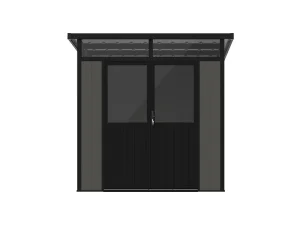
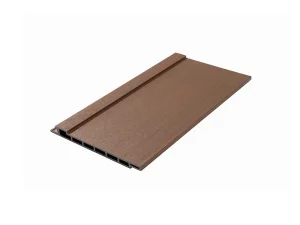
Complete your outdoor project specifications with matching co-extruded wall cladding, modular WPC garden sheds, and specialized commercial decking formulations.