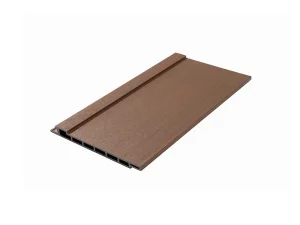
Primary Composite Innovations & Capped Profiles
Explore high-tensile co-extruded wood-plastic composite profiles, slip-resistant exterior boards, and weather-defying architectural exterior sidings engineered for international distribution.
The Global Commercial Landscape of Composite Decking
A deep dive into macroeconomic expansion, regulatory mandates against timber logging, and industrial supply chain integration across international construction markets.
Timber Replacement Inevitability
With stringent anti-deforestation laws (such as the EU Deforestation Regulation - EUDR) and escalating preservative chemical bans (Chromated Copper Arsenate restrictions), commercial procurement is migrating aggressively toward bio-composite extrusions. Real estate developers globally require long-lifecycle assets that eliminate seasonal chemical maintenance, biocides, and cyclical painting costs.
Industrial Supply Chain Scalability
Modern Wood Plastic Composite (WPC) manufacturing has evolved from early unshielded formulations to sophisticated multi-line co-extrusion technology. Centralized manufacturing plants provide unprecedented economies of scale, allowing containerized distribution that pairs modular decking profiles with matched cladding systems, structural joists, and architectural boundary solutions from a single quality ecosystem.
Total Cost of Ownership (TCO)
While initial material outlays for high-grade capped composites may exceed raw softwood planks, cumulative 5-year maintenance schedules demonstrate an estimated 42% TCO savings. The complete eradication of sanding, waterproofing emulsions, board replacements due to wet-rot, and contractor call-backs makes composite installations the gold standard for institutional infrastructure projects.
Advanced Extrusion Trends & Next-Gen Composite Ideas
Discover how proprietary surface science, micro-cellular foamed polymers, and thermo-reflective pigments are breaking historical composite performance limits.
Full 360° Shield Co-Extrusion
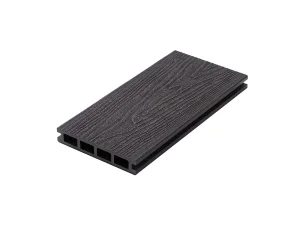
Early generation composites suffered from exposed moisture absorption inside the expansion grooves. Modern factories employ high-density modified polymer capping that encases the core completely—including bottom reliefs and tongue-and-groove joints—locking out rot, fungal decay, and organic oil penetration completely.
Solar Reflective IR Nanocoatings
A common consumer reservation regarding dark composite decking has been ambient heat absorption under direct sun. Cutting-edge manufacturing processes incorporate infrared-reflective mineral pigments within the outer shield, achieving a 20-30% reduction in surface heat dissipation relative to standard polymers for barefoot walking comfort.
Synchronized True-Touch Embossing
Moving far past repetitive artificial rubber-stamped patterns, modern twin-screw extrusion tooling utilizes non-repeating synchronized embossing drums. Deep variable woodgrains emulate European White Oak, Indonesian Teak, and Australian Spotted Gum with random tonal variegation and authentic timber tactile feels.
Mineral-Polymer Hybrids (MBC)
For extreme load requirements and zero-clearance installations near standing groundwater, factories have engineered Mineral Bio-Composites containing calcium carbonate and silica reinforcers. This achieves nearly zero thermal movement (under 0.05% expansion), permitting continuous runs without noticeable spacing gaps.
Localized Application Scenarios: Built for Harsh Climates
Real-world verification from verified commercial references across extreme global environmental zones, from Nordic permafrost to coastal salt fog.
Nordic Sub-Zero & Freeze-Thaw Zones
Tested Reference: Helsinki, Finland.
Timber structures subjected to cyclical freezing, snow accumulation, and springtime thawing experience cellular breakdown, checking, and screw detachment. High-density capped composite cores absorb under 0.2% moisture over 24-hour immersion testing, rendering them virtually immune to ice crystallization splitting and internal frost heave.
Arid & High-UV Sunbelts
Tested Reference: Dallas & Houston, USA.
Direct solar irradiation in southern latitudes induces intense color bleaching and thermal warping in low-grade plastics. Factory-engineered Hindered Amine Light Stabilizers (HALS) and dual-layer cross-linked shields maintain Delta E < 3.0 chromatic consistency over a decade of continuous high UV index exposure.
Marine & High-Humidity Environments
Tested Reference: Medellín & Coastal Latin America.
Constant humidity and saline spray degrade metal fixings and rot organic lumber rapidly. Utilizing non-metallic hidden T-clips and Austenitic 316-grade stainless steel clips in tandem with impervious polymer-shielded decking boards produces zero corrosion bleed, mildew colonization, or algae-induced slip hazards.
Industrial Specification & Material Testing Roadmap
Standardized engineering data evaluating physical performance against rigorous ASTM and EN standards for building inspectors, contractors, and project architects.
| Performance Criterion | Standard Softwood / Hardwood | 1st Gen Traditional WPC | Forestar Capped Engineered System |
|---|---|---|---|
| Bending Strength (MOR) | 18 - 32 MPa (Subject to knots) | 22 - 28 MPa | ≥ 38.5 MPa (High-density co-extruded) |
| Moisture Absorption (24h immersion) | 15.0% - 40.0% | 2.5% - 4.8% | ≤ 0.28% (Shield locked) |
| Slip Resistance (Pendulum Test) | PTV 24 - 35 (Slippery when wet) | PTV 36 - 42 | PTV ≥ 54 (Class P5 / R11 Anti-Slip) |
| Flame Spread Rating | Class D / E (Requires retro-treatment) | Class C (Standard plastics) | Class Bfl-s1 / ASTM E84 Class A Ready |
| Chemical / Stain Resistance | Porous, absorbs oils and wine quickly | Moderate staining risks | Zero staining (Tested with wine, mustard, oils) |
| Lifetime Recycled Composition | 0% (Harvested virgin wood) | 30% - 50% mixed inputs | Up to 90% reclaimed polymers & wood flour |
Direct OEM / ODM Factory Integration for Importers
Optimizing the wholesale pipeline from Anhui Fumeida New Material Technology Co., Ltd. direct to multi-national ports, retail home centers, and large-scale developers.
Consolidated Multi-Category Shipping
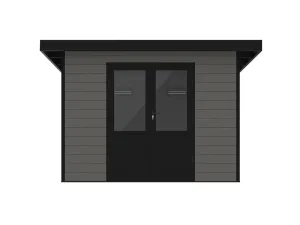
Importers maximize 40ft HQ container cubic utilization by consolidating complementary outdoor profiles within a single Bill of Lading. Mix composite deck boards, modular WPC wall cladding, interlocking fencing panels, and flat-pack garden shed components with precisely matching batch colors and synchronized delivery timelines.
Private Label Customization & Tooling
Empower your proprietary brand identity with turnkey OEM options. From proprietary profile extrusion dies, custom board widths (from narrow 90mm planks up to wide-plank 220mm spans), bespoke color matching based on Pantone references, to branded protective peel-off films and barcode-labeled export pallet bundling.
Traceable International Compliance
Navigating building safety codes is seamless with fully documented test dossiers. Batch-specific quality assurance certificates cover CE, ISO 9001, REACH environmental polymer safety, FSC-certified reclaimed wood fibers, and ASTM mechanical ratings, ensuring swift customs clearance and local council approvals worldwide.
Frequently Asked Questions for Importers & Contractors
Get immediate answers on technical specifications, container logistics, long-term durability, and substructure requirements.
What is the structural difference between uncapped composites and 360-degree capped composite boards?
Uncapped composite decking (1st generation) exposes the wood fiber and polymer blend directly to ambient air, rainfall, and UV exposure. Over time, uncapped boards can absorb moisture, leading to color fading, mold growth in humid areas, and organic surface stains. 360-degree capped decking incorporates a protective outer shield of modified high-density polymer covering all four sides and the clip channels, delivering complete stain resistance, UV stability, and moisture impermeability.
How does composite decking compare with hardwood in terms of fire resistance and commercial safety?
Untreated standard hardwoods typically achieve Class C or D flame spread ratings, generating intense thermal release upon ignition. High-specification capped composite decking is formulated with inorganic mineral flame-retardants in both the core and protective shell, attaining European Class Bfl-s1 or ASTM E84 Class A ratings upon specification, fulfilling strict commercial high-rise terrace and institutional compliance requirements.
What joist spacing and subframe configuration is required for composite deck boards?
For standard residential installations perpendicular to joists, we recommend maximum center-to-center spacing of 350mm to 400mm (16 inches). For heavy commercial foot traffic, public boardwalks, or diagonal (45-degree) plank designs, joist centers should be reduced to 300mm (12 inches). Subframes can be constructed from galvanized steel, aluminum extrusion profiles, or treated timber battens, ensuring a minimum 50mm clear airspace below for proper directional drainage.
Can overseas distributors order mixed product categories inside a single shipping container?
Yes. One of Forestar's primary factory advantages is multi-system production capacity. Distributors can mix capped composite decking boards, exterior WPC cladding, modular fence slats, and flat-pack garden shed kits in one consolidated container. This reduces warehouse inventory risk, simplifies custom clearance, and delivers harmonious surface textures and color palettes across comprehensive outdoor project specs.
How does the composite material behave under extreme temperature changes?
Like all thermoplastic-containing composites, WPC experiences thermal expansion and contraction primarily along its longitudinal profile. Forestar systems use high-grade polymer matrices with thermal expansion coefficients under 0.9 x 10^-4 mm/mm/°C. Standard hidden locking clips automatically preserve lateral spacing, while butt-joint gap charts ensure accurate spacing allowances based on ambient installation temperature.
Modular Composite Sheds, Cladding Systems & Poolside Solutions
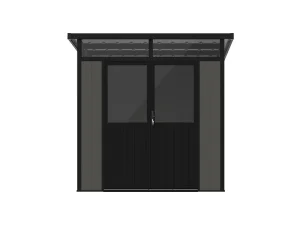
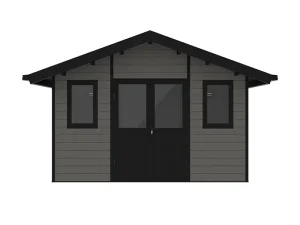
Explore heavy snow-rated backyard sheds, precision-milled exterior slatted claddings, and poolside composite decking engineered with eclipse grain technologies.