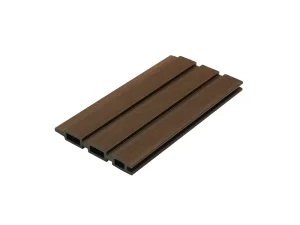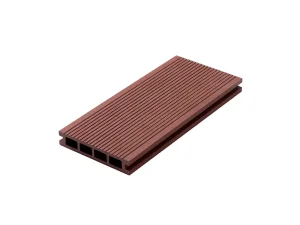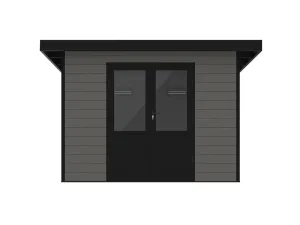
Engineered Architectural Profiles & Modular Assemblies
Factory-direct co-extruded decking planks, exterior cladding solutions, and modular garden structures precision-machined for commercial distributors, building merchants, and high-volume importers.
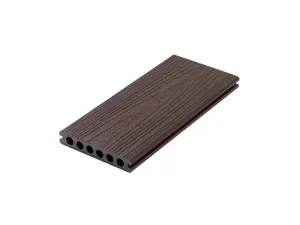
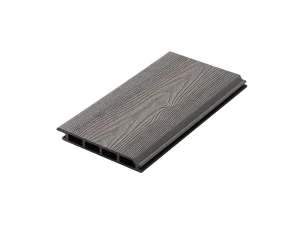
The 16 Ft Standard: Eliminating Butt Joints in Modern Deck Architecture
Modern outdoor deck building has evolved from modular segmenting to uninterrupted monolithic surfaces. In standard 12-foot or 10-foot decking layouts, field cuts and mid-span end joints create structural vulnerability points, accelerated moisture retention zones, and visual rhythm disruption.
Continuous Flexural Modulus
Extending profile length to precisely 16 feet (4.88 meters) increases continuous span load sharing across multiple joist runs. Manufactured with dense core matrices under 240-bar co-extrusion pressures, our 16-foot planks deliver an apparent Modulus of Elasticity (MOE) exceeding 3,200 MPa, preventing mid-span springiness and harmonic footfall vibration.
Total Butt-Joint Elimination
Residential patios and light-commercial terraces under 16 feet in width require zero end-to-end seams. By removing butt joints, contractors eradicate board lift, differential thermal cupping, and sistered double-joist framing expenses, saving up to 18% in framing sub-structure hardware and labor hours.
360-Degree Shield Shell
Long-span composite boards encounter increased solar thermal absorption. Our proprietary polyolefin-ionomer co-extruded cap encapsulates all four sides including the precision side-grooves, yielding an ultra-low linear thermal expansion coefficient (CLTE < 38 x 10⁻⁶ K⁻¹) to keep 16 ft boards perfectly aligned without warping.
Evaluating structural efficiency, framing substructure demands, and installation overhead across typical 400 sq.ft residential deck spans:
| Evaluation Parameter | Forestar 16 Ft Capped Composite | Standard 12 Ft WPC Planks | Traditional Pressure-Treated 16 Ft Pine |
|---|---|---|---|
| Field Butt Joints (Per 400 sq.ft) | 0 Joints (Continuous) | 16 to 24 Overlapping Joints | 0 Joints (Prone to Severe Twisting) |
| Substructure Sister Joists Required | None (Standard 16" o.c. joists) | Requires sistering at joint breaks | None initially (Requires blocking later) |
| Linear Thermal Expansion (CLTE) | 36.5 × 10⁻⁶ mm/mm/°C | 48.2 × 10⁻⁶ mm/mm/°C | Volumetric Shrinkage (Moisture-loss splits) |
| Surface Absorption Rate (24h immersion) | < 0.2% (Full Capped Barrier) | 0.8% - 1.4% (Uncapped Core Pores) | > 22.0% (Cellular swelling & rot) |
| 25-Year Lifecycle Maintenance Cost | $0 (Bi-annual washdown only) | Moderate (Joint re-fastening needed) | High (Annual staining, sealer, screw resets) |
Engineered Adaptation Across Continental Microclimates
A 16-foot profile experiences cumulative longitudinal thermal variance. Our global product formulations adapt raw composite polymers and co-extruded shield chemistries to the microclimatic realities of regional regulatory markets.
North American Suburbs & Resorts
Compliant with IRC (International Residential Code) span criteria. Perfect for spacious master multi-tier decks and picture-frame perimeter borders where 16-foot boards allow continuous edge wraps without broken miter joints, withstanding heavy Midwestern snow loads and high Texas UV radiation.
Nordic & Alpine Freeze-Thaw Zones
In Finland, Sweden, and Austria, extreme thermal swings cause rapid sub-zero contraction. Our micro-cellular matrix prevents internal interstitial water penetration, ensuring boards endure over 300 cyclic freeze-thaw tests (EN 15534-1) without micro-fissuring or capping delamination.
Mediterranean & Marine Boardwalks
Deployed across coastal Spain, Italy, and Greece. The high-density fluoropolymer-modified shield provides impenetrable defense against saline spray, chlorine pool splashing, and persistent pedestrian salt tracking, maintaining an anti-slip rating of R11 (DIN 51130) even when wet.
Oceania & Middle East High Solar
In Western Australia and Gulf Cooperation Council (GCC) regions, surface heat absorption is critical. Formulated with infrared-reflective cool-pigment technologies, our boards reduce heat buildup underfoot by up to 12°C compared to conventional dark WPC formulations.
China Factory Supply Chain Resilience & Precision Logistics
Producing true 16-foot composite deck boards requires advanced dual-extrusion tooling, long-bed cooling calibrations, and dedicated container stowage engineering. Based in Xuancheng, Anhui, our facility utilizes automated high-yield manufacturing lines to guarantee consistent delivery timelines worldwide.
Controlled Continuous Cooling Beds
Extruding 4.88m lengths introduces internal residual stress if cooled too rapidly. Our factory uses 32-meter multi-stage vacuum sizing and progressive temperature cooling tanks. This prevents curvature, bow, and internal stress voids, maintaining length tolerances within ±1.5mm.
High-Cube 40HQ Container Optimization
Shipping 16 ft (4.88m) bundles overseas demands meticulous volumetric planning. Standard 40HQ containers measure 12.03m inside, allowing two 4.88m bundles end-to-end with specialized protective end-caps, high-tensile steel strapping, and custom dunnage that prevents transit rubbing and edge crushing.
Raw Material Upstream Integration
We operate in-house pelletizing lines combining cleaned, post-industrial HDPE with kiln-dried 80-mesh hardwood fibers. By controlling masterbatch compounding directly on-site, we maintain strict batch-to-batch color delta (ΔE < 0.8) across multi-container supply contracts.
Technology Roadmap: Next-Gen Composite Horizons
The future of long-span outdoor architectural profiles focuses on sustainable carbon circularity, bio-hybrid polymer matrices, and advanced inline optical surface scanning.
Graphene-Infused Bio-Polymers
Our R&D pipeline integrates low-dosage functionalized graphene nanoplatelets into core co-extrusion layers. This structural matrix enhancement targets a 25% increase in flexural modulus, enabling joist spans up to 24 inches on-center for residential 16 ft decks without mid-span deflection.
100% Circular Closed-Loop Recovery
Developing post-consumer product takeback mechanisms alongside municipal recycling networks. Offcuts and dismantled first-generation WPC profiles are safely re-milled, cleaned, and reintroduced into core structural extrusions without sacrificing structural or capping durability.
AI Inline Laser Topography Scanning
Implementing sub-millimeter machine-vision laser inspection across all extrusion lines. High-speed optical sensors evaluate dimensional accuracy, groove profiles, and surface grain consistency across all 16 feet in real-time, automatically sorting out any profile exceeding variance thresholds.
Global Regulatory Assurance & Code Compliance
Cross-border sourcing requires dependable third-party verification. Our 16 ft deck boards are tested and certified to satisfy stringent international building standards, environmental rules, and fire classifications.
ASTM D7032 (North America)
Rigorous evaluation of flexural performance, concentrated load limits, fastener pull-through strength, and accelerated weathering under ultraviolet irradiance, maintaining structural performance on standard 16" o.c. framing.
EN 15534-1/4 (European Union)
Complete CE-marking compliance addressing swelling, impact resistance, creep behavior under sustained dead loads, and slip resistance under dry and wet shoe/barefoot scenarios across public boardwalk installations.
Reaction to Fire (EN 13501-1)
Certified to Class Bfl-s1 fire reaction requirements. Low smoke emission formulation minimizes toxic gas generation, meeting strict architectural specifications for multi-family balconies and light commercial corridors.
REACH & FSC Verification
Wood flours sourced from certified sustainably managed forests. Chemical formulations are free from heavy metals, phthalates, and hazardous SVHCs under European REACH regulations, guaranteeing safe residential application.
Frequently Asked Questions: 16 Ft Composite Decking
Crucial technical insights for project specifiers, commercial contractors, and international procurement managers sourcing 16-foot composite lumber systems.
Thermal movement on 16-foot boards accumulates over a longer single length compared to shorter 12-foot profiles. The linear expansion is calculated using the formula: ΔL = L × α × ΔT, where L is board length (4,880mm), α is our capped composite CLTE (approx. 3.6 × 10⁻⁵ mm/mm/°C), and ΔT is the difference between installation ambient temperature and seasonal maximum/minimum temperatures. For an anticipated 40°C temperature swing, total longitudinal movement is roughly 7.0mm. We recommend providing a 4.5mm to 6.0mm gap at each board terminus when installing at 20°C, and using slotted hidden clips that accommodate linear slide without binding.
For standard perpendicular residential decking subjected to 40 psf (1.92 kN/m²) uniform live load, maximum joist spacing is 16 inches (406mm) on-center. For 45-degree diagonal decking layouts, high-traffic commercial boardwalks, or perimeter stair treads, joist spacing must be reduced to 12 inches (305mm) on-center. This prevents dynamic spring deflection and preserves long-term horizontal line consistency.
The 16-foot profile represents the industry's optimal balance between seamless visual architecture and practical freight handling. While 12-foot boards leave frequent joints across standard suburban deck dimensions (which typically measure 14 to 16 feet wide), 20-foot boards create higher shipping costs and pose site maneuvering challenges in compact yards. The 16 ft length eliminates visible butt joints across typical master decks while fitting cleanly within export shipping containers without excessive handling risk.
Long composite extrusions can exhibit bow or camber if cooling water bath temperatures vary. Our production lines use multi-zone vacuum calibrators and automated downstream fly-cutters linked to precision encoders. Boards travel across extended 32-meter temperature-stepped cooling channels, keeping longitudinal camber below 1.5mm per full 4.88m plank—well within European EN 15534-4 and American ASTM tolerances.
We recommend marine-grade 304 or 316 stainless-steel hidden clip systems featuring glass-filled polyoxymethylene (POM) spacers. These clips set a uniform 4mm to 5mm side drainage gap while giving the 16-foot plank freedom for seasonal thermal expansion and contraction along the joist axis, preventing screw shearing and board buckling.
Pallets are constructed using specialized continuous softwood runners with bottom forklift entry channels. Planks are interlocked with PE protective films, protected by heavy cardboard edge guards, and secured with multi-point steel strapping. In a 40HQ container, two 4.88m pallets sit in series with tailored dunnage bags, allowing forklift pull-out systems or roll-off unloading at your regional distribution yard.
Extended Architectural Collection: Decking, Fencing & Modular Enclosures
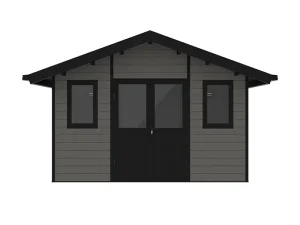
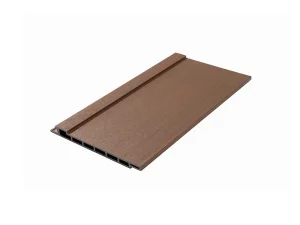
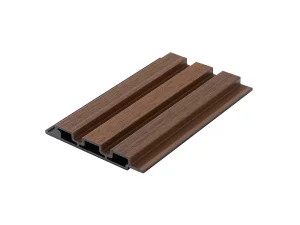
Combine your 16 ft deck board container orders with matching co-extruded wall cladding, hidden-fastener security fencing, and heavy snow-rated garden sheds for unified container logistics.