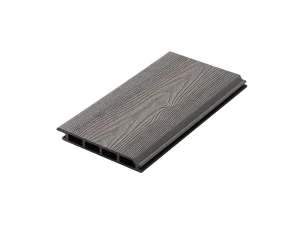
Engineered Composite Cladding & Outdoor Architectural Systems
Explore our premium factory-direct composite systems manufactured under ISO 9001 and strict ASTM / EN standards. Designed for high weather resistance, thermal stability, and enduring aesthetics.
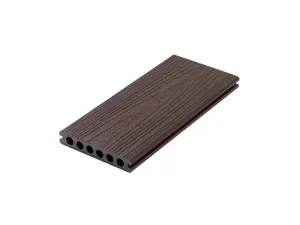
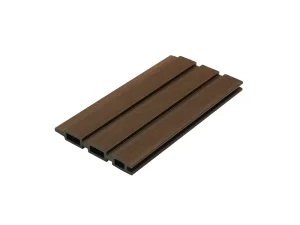
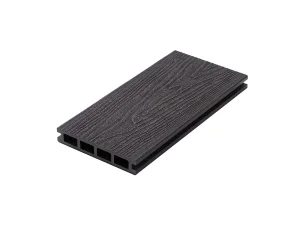
Evolution of Architectural Cladding Panels: The Rise of High-Performance WPC Rainscreens
A comprehensive examination of how structural polymer science, ventilated façade engineering, and stringent fire regulations are revolutionizing exterior building envelopes across commercial and residential developments.
Thermal Bridging & Envelope Efficiency
Modern building codes (such as ASHRAE 90.1, IECC, and European EPBD standards) demand the total mitigation of thermal bridges. Traditional masonry and metal cladding systems often create conductively parasitic paths through substructure anchors. Modern engineered WPC cladding acts as a thermal break, reducing building HVAC energy loss by up to 28% while buffering high solar thermal radiation.
Ventilated Rainscreen Aerodynamics
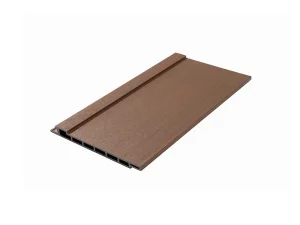
The transition from face-sealed exterior walls to pressure-equalized ventilated rainscreens has revolutionized moisture management. Our precision-milled tongue-and-groove and open-joint composite panels allow a continuous 20mm-50mm cavity airflow, driving chimney-effect thermodynamic circulation that continuously evaporates interstitial condensation and guards structural sheathing from mold, decay, and rot.
360° Co-Extruded Fluoropolymer Shielding
First-generation mono-extruded composites suffered from oxidation, color fading, and surface oil staining. Leading manufacturers now employ advanced multi-manifold co-extrusion technology, fusing an ultra-dense, modified polymer cap layer loaded with Hindered Amine Light Stabilizers (HALS) and inorganic ceramic pigments directly over a dense cellulose-polymer core during the molten phase.
Enterprise Procurement Criteria: How Importers & EPC Giants Select Cladding Factories
A pragmatic evaluation framework for multinational distributors, Tier-1 general contractors, and façade engineering consultants vetting Chinese manufacturing partners for multi-container and project-tender reliability.
Batch Consistency & Spectrophotometry
Color delta (ΔE) control across separate manufacturing lots is critical for phased building construction. High-volume procurement contracts mandate automated in-line spectrophotometer color verification maintaining ΔE < 0.8 under D65 daylight simulation, preventing visual checkerboarding on extensive elevations.
Creep Rupture & Flexural Longevity
Long-term exposure to cyclic wind load requires superior flexural modulus (exceeding 3,200 MPa) and resistance to static creep deformation. Industrial testing validates panel deflection under sustained negative wind suction loads up to 3.5 kPa without fastener pull-through or slot fracture.
Supply Chain Traceability & LCA
Tier-1 infrastructure procurement requires Environmental Product Declarations (EPD) and Life Cycle Assessment (LCA) verification. Factory-level fiber tracing must demonstrate 100% FSC-certified or reclaimed post-industrial wood flour integrated with recycled high-density polyethylene (HDPE).
Direct Tooling & Custom Extrusion Dies
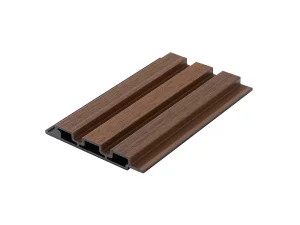
Architectural portfolios frequently require bespoke fluted, slatted, or shiplap profiles. A tier-one factory maintains an in-house precision EDM mold-making facility, cutting custom extrusion tooling cycles down to 14 days and enabling customized profiles with tailored clip-lock geometries.
Material Science Benchmark: Co-Extruded WPC vs. Fiber Cement vs. Hardwood vs. Aluminum
A rigorous performance comparison illustrating how modern co-extruded wood-plastic composite balances tensile strength, weight-to-span ratios, fire reaction, thermal conductivity, and total operational cost over a 30-year design life.
| Performance Metrics | Forestar Capped WPC Panels | Fiber Cement Board | Kiln-Dried Hardwood Siding | Solid Aluminum Panels (3mm) |
|---|---|---|---|---|
| Density & Specific Gravity | 1.30 - 1.38 g/cm³ (High Rigidity) | 1.45 - 1.65 g/cm³ (Brittle) | 0.75 - 0.95 g/cm³ (Moisture Variable) | 2.70 g/cm³ (Ductile) |
| Moisture Absorption (24h immersion) | < 0.2% (Impermeable Shell) | 8.0% - 15.0% (Capillary Uptake) | 18.0% - 35.0% (Swelling / Warping) | 0.0% (Impermeable) |
| Thermal Conductivity (W/m·K) | 0.15 - 0.19 (Insulating Barrier) | 0.25 - 0.35 (Moderate) | 0.13 - 0.17 (Natural Insulator) | 160 - 210 (Severe Thermal Bridge) |
| Fire Reaction Classification | EN 13501-1 Class B-s1, d0 / ASTM E84 Class A | EN 13501-1 Class A1 / Non-combustible | EN 13501-1 Class D / Highly combustible | EN 13501-1 Class A2 / Non-combustible |
| UV Color Fastness (QUV 3000h) | ΔE ≤ 1.2 (Nano-Pigment Shell) | ΔE ≤ 2.5 (Requires Topcoat) | Severe Graying (Requires Annual Staining) | ΔE ≤ 1.5 (PVDF Coating) |
| Recycled Composition | Up to 90% (Circularity Certified) | < 10% (Silica / Virgin Portland Cement) | 0% (Harvested Virgin Timber) | 20% - 40% (Energy-Intensive Smelt) |
| Maintenance Overhead (30-Year) | Zero Staining / Power Wash Only | Repainting Every 7–10 Years | Annual Oiling, Sanding & Sealing | Periodic Chemical Degreasing |
Global Regulatory Conformance: Cross-Border Compliance for Municipal Projects
Procuring exterior building envelope materials across international jurisdictions requires ironclad laboratory certification and full alignment with regional building performance codes.
North America: ASTM & NFPA 285
Forestar composite cladding profiles undergo rigorous testing according to ASTM E84 (Standard Test Method for Surface Burning Characteristics of Building Materials), achieving a Flame Spread Index (FSI) < 25 and Smoke Developed Index (SDI) < 450 (Class A). Assemblies are tested under NFPA 285 protocols to ensure vertical and lateral flame spread resistance across non-combustible exterior multi-story curtain walls.
European Union: CE, EN 13501 & REACH
Compliant with the Construction Products Regulation (CPR 305/2011/EU), our cladding carries standard CE marking verified by notified bodies. Fire testing reaches EN 13501-1 Class B-s1, d0 (combustion resistance with minimal smoke emission and zero burning droplets). Chemical integrity meets EU REACH (EC 1907/2006) zero SVHC (Substances of Very High Concern) thresholds, ensuring non-toxic lifecycle operation.
Oceania: AS/NZS 1530 & Bushfire (BAL)
Engineered for harsh Australasian UV indices and bushfire exposure, panels are tested to AS/NZS 1530.3 (Early Fire Hazard Test) and evaluated for compliance with AS 3959 for Bushfire Attack Level (BAL) construction. Hidden clips and subframe brackets are fabricated from 304/316 marine-grade stainless steel to resist severe coastal salt spray corrosion.
Technical Roadmap: Next-Generation Innovations in Exterior Cladding Systems
How Forestar is pioneering material formulations, robotic extrusion lines, and smart envelope integration to future-proof exterior cladding for the circular economy.
Infrared-Reflective Cool Pigment Chemistry
Rising global temperatures have accelerated the demand for thermally reflective facades. Our next-generation co-extrusion formulation incorporates NIR (Near-Infrared) reflective mineral pigments. By bouncing back up to 65% of the solar infrared spectrum, surface temperatures remain up to 15°C cooler than conventional composites, curbing thermal expansion and preventing heat island phenomena.
AI-Powered Real-Time Die Swell Optimization
Forestar's smart factory extruders employ automated machine vision and laser triangulation profiling sensors at the extrusion head. The AI closed-loop control system automatically modulates barrel temperature profiles, feed screw RPMs, and vacuum calibrator pressures in real time, eliminating dimensional warping, micro-voids, and thickness variance to within ±0.15mm tolerances.
BIPV Architectural Envelope Integration
Looking toward net-zero building directives, our R&D center is testing Building-Integrated Photovoltaic (BIPV) composite facades. By integrating thin-film perovskite-silicon solar cells directly flush within specialized fluted composite panel channels, future exterior claddings will generate green electricity silently without compromising aesthetic woodgrain elegance.
Frequently Asked Questions: Technical Engineering & Global Sourcing
Detailed technical answers addressing core engineering, installation physics, batch lead-times, and customized OEM supply for professional cladding procurement.
How does WPC cladding accommodate thermal expansion across extreme climates?
Engineered composite cladding exhibits a linear thermal expansion coefficient of approximately 2.5 - 3.5 × 10⁻⁵ mm/mm/°C. Our patented hidden fastening systems feature elongated slotted clips that provide positive retention while allowing frictionless horizontal micro-expansion and contraction. Factory guidelines define precise joint expansion gaps (typically 3mm to 6mm depending on ambient installation temperature) to eliminate buckling or surface distortion from -40°C Nordic winters to +55°C Middle Eastern summers.
What is the structural wind load resistance of your cladding profiles?
Our cladding panel systems are tested in accordance with ASTM E330 (Standard Test Method for Structural Performance of Exterior Windows, Doors, Skylights and Curtain Walls by Uniform Static Air Pressure Difference). Installed over recommended aluminum or galvanized steel batten spacings of 400mm on-center, our assemblies withstand wind pressures exceeding ±3.5 kPa (equivalent to Category 5 hurricane-force gusts over 240 km/h) without permanent plastic deformation or clip detachment.
Can you provide custom RAL color-matching and bespoke architectural embossing?
Yes. Our in-house masterbatch color laboratory utilizes digital color spectrometry to formulate custom colorations according to international RAL, Pantone, or submitted natural wood specimens. We also maintain CNC tooling centers capable of texturing extrusion embossing cylinders with bespoke linear brushed, wire-brushed, deep woodgrain, or monolithic architectural matte finishes, with minimum order quantities as accessible as a single 20ft container.
How does the composite core prevent organic biological degradation?
Unlike natural timber, which absorbs moisture and facilitates mycelial fungi proliferation, our wood fiber component is micro-pulverized, oven-dehydrated to <1% moisture content, and completely encapsulated within molten high-density polyethylene polymer under intense heat and pressure. This total encapsulation creates a non-porous barrier that prevents moisture ingress, depriving wood decay fungi, termites, and wood-boring insects of nourishment.
What is the standard production lead time and export container loadability?
Standard profile production cycles run between 14 and 21 days for standard 40ft High Cube containers (typically containing 1,800 to 2,400 square meters of paneling depending on profile profile thickness). Each crate is packed with moisture-barrier film and heavy-duty corner guards on reinforced fumigated timber skids, engineered to fit maritime container dimensions precisely and facilitate rapid forklift unstuffing at destination ports.
Can your factory support mixed-product container consolidation?
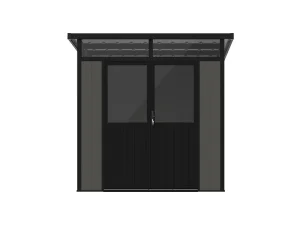
Yes. As a comprehensive outdoor composite manufacturing hub operating over multiple specialized extrusion and assembly lines, we enable global distributors to consolidate co-extruded wall cladding, exterior decking boards, modular privacy fencing screens, and flat-pack outdoor composite sheds within a single unified shipping container, maximizing capital turnover and freight efficiency.
Engineered Cladding & Integrated Outdoor Systems (Series II)
Explore additional high-grade cladding profiles and complementary outdoor architectural elements engineered for low maintenance, UV defense, and long-term durability.