
2026 Best WPC Panel for Global Buyers?
Table of Contents
- WPC Panel Composition: 50–70% Wood Fiber and 30–50% Polymer
- Fire Performance: ASTM E84 Class A and EN 13501-1 B-s1,d0 Ratings
- Moisture Durability: ASTM D570 Water Absorption and UV Exposure Testing
- Global Compliance: CE, REACH, RoHS, FSC, and ISO 9001 Documentation
- 2026 Buyer Scorecard: Density, Thickness, MOQ, Lead Time, and Warranty
- FAQS
- Conclusion
- Related Posts
Choosing the 2026 best Wpc Panel requires more than comparing colors, prices, or attractive product photos. Global buyers need evidence that supports each performance claim. A Wpc Panel may look excellent in a showroom, yet react differently under coastal humidity, strong sunlight, or rapid temperature changes. Installation quality also matters. Poor spacing can cause warping, even when the panel itself meets specifications. No panel wins everywhere.
This guide examines practical factors that experienced buyers should verify before placing an international order. We consider water resistance, dimensional stability, surface durability, fire performance, emissions, and maintenance needs. Independent laboratory reports can reveal more than a supplier’s brochure. Supplier experience matters, too. A polished catalog is not enough. Buyers should request technical data, production samples, packaging details, and references from completed projects. We also examine color consistency, minimum order quantities, lead times, replacement policies, and communication during production. A low purchase price may become expensive after freight damage, installation delays, or inconsistent batches.
The strongest choice is rarely the most heavily advertised product. It should balance technical performance, local climate, budget, design expectations, and long-term service. We will compare realistic use cases, from hotel walls and retail interiors to residential renovations and commercial ceilings. Real projects reveal practical weaknesses. Some recommendations may not suit every market, and that is intentional. Material performance depends on testing methods, building conditions, and installer skill. Buyers should question broad claims, verify current certifications, and request samples before committing. Careful decisions may take longer, but they reduce avoidable risks across borders.
WPC Panel Composition: 50–70% Wood Fiber and 30–50% Polymer
2026 Best WPC Panel for Global Buyers?
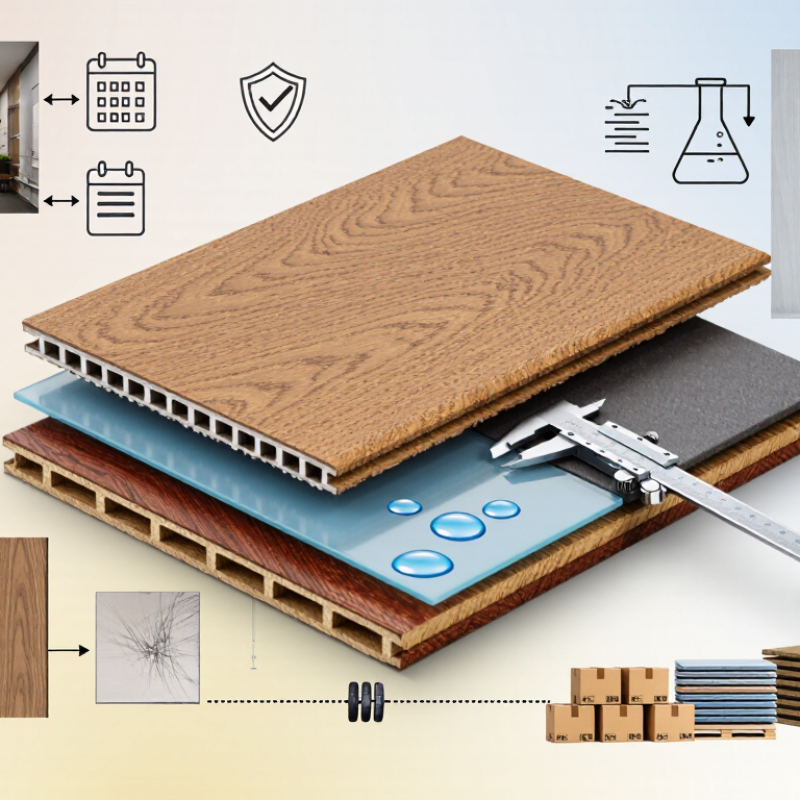
WPC panel composition usually contains 50–70% wood fiber and 30–50% polymer. This balance affects stiffness, moisture resistance, weight, and surface texture. Grand View Research estimated the global wood plastic composites market at about USD 7.3 billion in 2023. Its 2024 report also projected strong growth through 2030. These figures support demand, but market forecasts are not performance guarantees.
Higher wood content can create a warmer, more natural appearance. However, it may increase water absorption if fiber treatment and extrusion control are weak. Higher polymer content can improve moisture resistance and dimensional stability. It may also reduce surface grip and increase thermal expansion. A panel that feels rigid indoors can still move under direct sunlight. Small details matter.
Global buyers should request composition records, density data, water absorption results, and thermal expansion tests. ISO 16616 provides a relevant framework for evaluating WPC profiles, although panel structures can vary. Laboratory data should match the production batch, not only a showroom sample. This is often overlooked.
A practical inspection should include edge cutting, screw holding, surface bonding, and short-term water exposure. The 50–70% wood range is useful, but it is not a universal formula. Filler type, fiber length, polymer selection, and processing temperature can change the result significantly.
Fire Performance: ASTM E84 Class A and EN 13501-1 B-s1,d0 Ratings
2026 Best WPC Panel for Global Buyers?
Fire Performance: ASTM E84 Class A and EN 13501-1 B-s1,d0 Ratings
For global buyers, fire documentation should guide every WPC panel decision. ASTM E84 Class A means a flame-spread index of 25 or less and a smoke-developed index of 450 or less. EN 13501-1 B-s1,d0 indicates limited fire contribution, low smoke production, and no flaming droplets. These ratings describe tested performance, not an automatic guarantee for every installation. The panel thickness, backing material, adhesive, air gap, and fixing method can change results.
The risk deserves attention. NFPA’s Fire Loss in the United States report recorded about 1.39 million fires in 2023. Building materials cannot prevent every incident, but tested surface behavior may reduce early flame and smoke movement. Buyers should request complete laboratory reports, not only a sales sheet. Check the test date, specimen construction, mounting method, and production batch. A certificate without these details is difficult to verify.
Tips: Ask whether the rating covers the complete wall system. Confirm that the installed panel matches the tested composition. Require both ASTM E84 and EN 13501-1 evidence when serving North American and European projects. Ratings are not magic shields. Installation quality still matters. Even experienced teams can overlook concealed cavities, service penetrations, or unsuitable adhesives. Review these weak points before approving samples.
Moisture Durability: ASTM D570 Water Absorption and UV Exposure Testing
2026 Best WPC Panel for Global Buyers?
Moisture resistance should be measured, not assumed. ASTM D570 water absorption testing records how much water a WPC panel gains after immersion. A practical evaluation begins with conditioned specimens, accurate weighing, and sealed test records. Inspectors should also examine edges, cut surfaces, and fastener holes. These areas often absorb water faster than the panel face. Small details matter.
UV exposure testing adds another layer of evidence. Controlled ultraviolet radiation, heat, and moisture cycles can reveal fading, chalking, surface cracking, or loss of stiffness. Compare exposed samples with unexposed controls under consistent lighting. Color change may look minor in a laboratory, yet become obvious on a large exterior wall. Test results should state exposure duration, cycle conditions, specimen thickness, and visual changes.
Tips: Request ASTM D570 data with sample dimensions and immersion time. Ask for UV test conditions, photographs, and post-test measurements. Test the actual color and surface finish, not only a similar sample. Keep installation climate in mind. A dry laboratory is not a coastal site. Also, one test cannot predict every application. Real projects include drainage errors, poor ventilation, and repeated wetting. That is where specifications need honest review.
2026 Best WPC Panel for Global Buyers? - Moisture Durability: ASTM D570 Water Absorption and UV Exposure Testing
Technical comparison framework for moisture resistance, dimensional stability, and accelerated weathering performance
| Evaluation dimension | Test method / reference | Recommended test conditions | Indicative technical range for comparative screening | Buyer interpretation |
|---|---|---|---|---|
| 24-hour water absorption | ASTM D570, 24-hour immersion procedure | Condition specimens at 23 ± 2°C; record dry mass, immerse in distilled water for 24 hours, then surface-dry and reweigh. | ≤2.0%: strong screening result 2.0–5.0%: moderate moisture uptake >5.0%: higher moisture risk |
Lower absorption generally reduces swelling, edge deterioration, staining, and freeze–thaw-related damage. Compare panels at the same thickness and specimen orientation. |
| Longer-term water absorption | ASTM D570 extended immersion or project-specific moisture protocol | Measure mass change after 7 and 28 days, with periodic dimensional readings. | ≤4% after 28 days: favorable screening result 4–8%: application-dependent >8%: investigate formulation and sealing |
Useful for bathrooms, humid climates, exterior façades, and installations exposed to repeated wetting rather than a single short immersion. |
| Thickness swelling after immersion | Project specification; measure before and after ASTM D570 conditioning | Measure thickness at defined points before immersion and after 24 hours or the selected extended period. | ≤1.0%: low movement 1.0–3.0%: moderate movement >3.0%: review joints and installation clearances |
Important for tongue-and-groove panels, tight joints, concealed fixing systems, and installations with limited expansion space. |
| Water absorption by panel construction | ASTM D570 comparison using equivalent specimen geometry | Test solid, hollow, capped, and uncapped sections separately when the design contains different exposed surfaces. | Solid capped: commonly targeted at ≤2% Solid uncapped: commonly targeted at ≤3% Hollow or open-ended: may exceed 3% unless ends are sealed |
A capped surface can reduce liquid-water entry, but cut edges, drill holes, open cells, and unsealed ends may remain vulnerable. |
| Accelerated UV exposure | ASTM G154 fluorescent UV or ASTM G155 xenon-arc exposure | Use a documented cycle, irradiance, black-panel temperature, condensation or water spray condition, and total exposure time. A 1,000-hour screening cycle is commonly specified by projects. | Target: no cracking, blistering, or delamination; color change agreed before testing | ASTM G154 and G155 provide exposure procedures, not a universal outdoor-service-life prediction. Always request the complete cycle and irradiance details. |
| Color change after UV exposure | ASTM G154/G155 exposure; color measurement using CIE L*a*b* and ΔE | Measure initial and post-exposure color at the same locations, using the same illuminant and observer settings. | ΔE ≤3: low visible change ΔE 3–5: moderate visible change ΔE >5: clearly visible change |
ΔE is a color-difference value, not a direct service-life measurement. Dark colors and wood-grain finishes may show different visual tolerances. |
| Gloss retention after UV exposure | ASTM G154/G155 exposure; gloss measurement commonly referenced to ASTM D523 | Measure at the same geometry, typically 60°, before and after exposure; report percentage retention. | ≥80% retention: strong appearance stability 60–80%: moderate change <60%: noticeable surface change |
Best used with ΔE and visual inspection because matte, embossed, and textured finishes can produce lower or more variable gloss readings. |
| Surface integrity after UV exposure | Visual inspection after ASTM G154/G155 exposure | Inspect under controlled lighting for chalking, cracking, blistering, delamination, fiber exposure, and surface erosion. | Preferred: no cracks, blisters, delamination, or exposed fibers Reject or investigate: structural cracks or layer separation |
For exterior use, physical surface damage is often more significant than moderate color fading. |
| Moisture–UV combined durability | Sequential or cyclic project protocol using ASTM D570 and ASTM G154/G155 references | Condition specimens through wetting, drying, UV, and cooling cycles; record mass, dimensions, color, and surface defects. | Preferred outcome: water absorption remains within the agreed limit, no delamination, and ΔE remains within the project limit. | This approach better represents exposed façades, covered outdoor areas, coastal climates, and regions with repeated rain and strong sunlight. |
Global Compliance: CE, REACH, RoHS, FSC, and ISO 9001 Documentation
2026 Best WPC Panel for Global Buyers?
For global buyers, compliance documents matter as much as surface finish. A reliable WPC panel supplier should provide a clear CE assessment when the product falls under applicable European construction rules. CE is not a universal quality label. REACH evidence should identify restricted substances, test methods, and laboratory dates. RoHS documentation is also product-specific, especially for panels used near electrical assemblies.
FSC claims require careful checking. The FSC Facts & Figures report records more than 160 million hectares of certified forest worldwide, but certification applies to controlled material flows. Ask for a valid chain-of-custody certificate, not only an FSC logo. That distinction is easy to miss. It may affect project approval.
ISO 9001 supports process reliability, not automatic product safety. The ISO Survey 2023 recorded more than 1.26 million ISO 9001 certificates globally, showing its broad use in quality management. Still, buyers should review inspection records, batch traceability, moisture testing, and dimensional tolerances. A practical compliance file should include declarations, current test reports, safety data, and factory procedures. Check whether each document names the same model, material composition, and production site. Some suppliers submit polished files with outdated product codes. That is a warning sign. Clear documentation reduces customs delays and supports responsible sourcing.
2026 Buyer Scorecard: Density, Thickness, MOQ, Lead Time, and Warranty
2026 Best WPC Panel for Global Buyers?
Global buyers need a measurable scorecard, not attractive samples alone. Grand View Research estimates the global WPC market will grow at about 7% annually through 2030. Mordor Intelligence also identifies construction and interior applications as major demand areas. That growth increases comparison pressure.
Density deserves the first check. For interior panels, 0.55–0.75 g/cm³ often balances stiffness and handling. However, testing methods can change results. Request ISO 1183 or ASTM D792 data. Do not trust a claimed number without a batch report. Thickness affects installation and perceived value. An 8–12 mm panel may suit many interiors, while thinner stock can reveal uneven walls. Ask for tolerance, not only nominal thickness.
MOQ is commercial risk. A 300–500 square metre trial order is easier than a container-scale commitment. Lead time should separate production, curing, packing, and ocean transit. A practical target is 15–30 production days, excluding customs. These are benchmarks, not universal rules.
Warranty language needs equal scrutiny. Specify years, fading limits, moisture exposure, installation exclusions, and replacement procedures. Five to ten years is common in quotations, yet duration alone proves little. ASTM D2244 testing can help define colour-change claims.
My scorecard is imperfect: density 25%, thickness 20%, lead time 20%, warranty 20%, and MOQ 15%. Projects near ports may weight lead time higher. Small omissions become expensive.
FAQS
Most panels contain 50–70% wood fiber and 30–50% polymer. Higher fiber content may create a warmer, natural texture. Higher polymer content usually improves moisture resistance. The formula is not universal.
Wood fiber can increase stiffness and visual warmth. Poor fiber treatment may increase water absorption. Polymer can improve dimensional stability. It may also increase thermal expansion under sunlight.
Request composition records, density data, water absorption results, and thermal expansion tests. The data should match the production batch. A showroom sample is not enough.
Inspect a cut edge and test screw holding. Check surface bonding and short-term water exposure. Look for swelling, cracking, or weak adhesion. Small tests reveal hidden problems.
ASTM E84 Class A indicates limited flame spread and smoke development. EN 13501-1 B-s1,d0 indicates limited fire contribution, low smoke, and no flaming droplets. These ratings describe tested conditions. They are not magic shields.
No. Thickness, backing, adhesive, air gaps, and fixing methods can change performance. Ask whether the test covers the complete wall system. Check cavities and service penetrations carefully. Installation still matters.
Interior panels often use about 0.55–0.75 g/cm³ density. An 8–12 mm thickness may suit many interior applications. Request testing standards and tolerance data. Nominal figures can mislead.
A 300–500 square metre trial order may reduce commercial risk. Separate production, curing, packing, and ocean transit times. A 15–30 day production target can be practical. Customs delays remain possible.
Check warranty years, fading limits, moisture exposure, and installation exclusions. Replacement procedures should be written clearly. Five to ten years sounds useful, but duration alone proves little. My scorecard may still need adjustment.
Conclusion
Choosing the right Wpc Panel in 2026 requires a clear evaluation of composition, performance, compliance, and supply capability. A quality panel typically contains 50–70% wood fiber and 30–50% polymer, balancing natural appearance, structural stability, and processing performance. Buyers should review fire-safety evidence, including ASTM E84 Class A and EN 13501-1 B-s1,d0 ratings where applicable. Moisture durability should also be supported by ASTM D570 water-absorption data and UV exposure testing to confirm suitability for humid or sun-exposed environments.
For international purchasing, reliable documentation is essential. CE, REACH, RoHS, FSC, and ISO 9001 records can help verify responsible sourcing, material safety, and quality-management practices. A practical 2026 buyer scorecard should compare density, thickness tolerance, minimum order quantity, lead time, packaging, and warranty terms. By assessing these factors together rather than focusing only on price, global buyers can select a Wpc Panel that offers dependable performance, regulatory readiness, and long-term value across different construction and interior applications.

Blog Tags: